About Jill: from Taiwan to Houston, and putting down roots
In 1999, I crossed the ocean from Taiwan to Houston. I never imagined I would put down roots here, or as Americans say, “call it home.” In my first few months at the University of Houston (UH), I kept asking myself how I had ended up somewhere so remote! In 1999 the area around UH felt empty, a world away from the convenience and buzz of Taipei. Between homesickness and the pressure of school, all I wanted was to fly back to Taiwan. But people are remarkably adaptable: after finishing graduate school in a year and a half, I found a job, fell in love, and made my home here!
Below, I share the areas I have lived in over the years, and show you how Houston has changed.
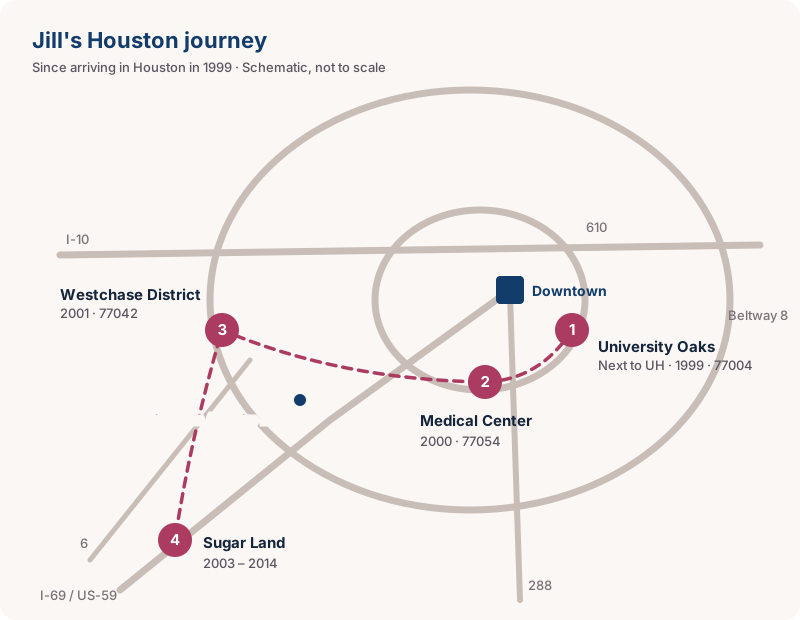
University Oaks, next to UH (77004)
While I was a student, a classmate introduced me to a garage apartment behind a single-family home on Varsity Lane, in the University Oaks neighborhood just south of Wheeler Street. The two-car garage had been converted into a studio-style unit with a kitchen and a bathroom; you opened the door and there was the bed. Rent was $350 a month, utilities included. The price of cheap rent was sharing my late-night study sessions with countless cockroaches!
University Oaks today is a different place. The light rail on Wheeler is running, UH has climbed in the rankings, and it is easy to get to work Downtown by car or by train. The neighborhood has a long history; it sits just south of UH and was home to many UH professors in its early days. Using January 2016 data as an example: a 1939 home with 2,171 sq ft was listed at $325,000 and received multiple offers, and a newly built 2011 home with 4,702 sq ft, listed at $825,000, was already under contract.
Medical Center (77054)
At the time, many of my classmates lived in apartments near the Medical Center (around 288 and 610, Fannin, Almeda, Cambridge and NRG Stadium). In my last semester, tired of my nightly cockroach visitors, I found a roommate and moved into a two-bedroom, two-bath apartment near the Medical Center. Rent was $750 a month, about $375 each, with water included and electricity extra. My quality of life improved a lot.
By 2016, two-bedroom, two-bath rents in this area were close to double what they were in 1999, ranging from $1,150 to more than $3,000 a month depending on size, age and whether a garage was included. The area works well for UH students and for people who work in the Medical Center or Downtown, with short commutes and bus service. But in Houston, not having a car is like not having legs! Buses take a lot of time and run less often on weekends, so driving is still the most convenient way to get around.
Westchase District, along Beltway 8 (77042)
After graduating from UH, I found a job in Stafford. I didn’t know Houston well yet, so I rented a one-bedroom, one-bath apartment of less than 500 sq ft in the Westchase District for $425 a month. There wasn’t even a door between the bedroom and the living room and kitchen.
The Westchase District sits between Beltway 8, Richmond Avenue and Westheimer. There are many apartments near Richmond, Westpark and the Beltway, from individually owned units to large apartment communities. North of Westheimer, west of the Beltway, are some older neighborhoods such as Walnut Bend and Briar Forest. Around 2000, homes there sold for about $200,000; by 2016, nicely renovated older homes were asking around $400,000. Daily conveniences are good, with Whole Foods, Target and plenty of restaurants along Westheimer, office buildings along Richmond, and Chinatown on Bellaire Boulevard only about ten minutes away. Conditions vary from one subdivision to the next, so I suggest driving around both during the day and at night. You’ll see what I mean!
Sugar Land
After a year and a half in Westchase, my apartment was raising the rent again, so I decided to move closer to work. In Sugar Land, next to the private Sugar Creek Country Club golf course, I found a townhouse for sale in Westmont Square: a corner unit with two bedrooms, two baths, a two-car garage, about 1,600 sq ft and a small yard. Most important of all, it was only a three-minute drive to work! I often told my coworkers that I got to the office before my car had even warmed up. (When I first arrived in the U.S. in 1999, gas was just $0.99 a gallon.)
In 2003, I bought the townhouse with a Chase loan for 80% of the price and a 20% down payment, at a 6% rate. I chose a 5/1 ARM, an adjustable-rate mortgage that is fixed for the first five years and then adjusts every year. Luckily, when the rate started adjusting in year six, the subprime crisis hit and rates kept falling. By the time I sold the home in 2014, my rate was only 2.35%. I was very lucky! With the $245 monthly HOA fee, my mortgage plus HOA came to less than $500 a month. Adding property taxes and insurance, it was about $800 a month, plus home maintenance, of course.
After moving to Sugar Land, I gradually got to know the city. Sugar Land’s commercial areas are concentrated along Highway 6, with a small industrial area near Highway 90 and US-59. Sugar Land’s Clements High School is well known and has produced a number of U.S. Presidential Scholars, and homes zoned to it have always been in demand.
But scores aren’t everything. U.S. college admissions also place a lot of weight on students’ activities outside the classroom. There’s nothing wrong with wanting to give your children a head start, but after sending them to school, parents still need to spend time with them and guide them. If a child scores 100 on every test but doesn’t know how to treat others or respect their teachers, that isn’t ideal either, is it?
Follow Jill on X (Twitter) for Houston real estate news and tips: @JillTsa41296412
Jill works alongside your lender, tax advisor and financial planner. TYC Realty does not provide tax, legal or investment advice.